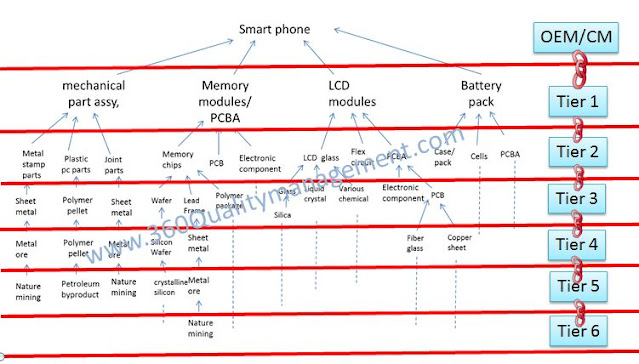
In today's fast-paced world, the journey from raw materials to the finished products we love is no longer a one-person show. It's a thrilling collaboration that involves a network of manufacturing facilities, forming what we call the product supply chain. This chain links the suppliers of raw materials to the eager hands of consumers, passing through various tiers of suppliers along the way.
Imagine this: every manufacturer depends on their upstream suppliers for essential parts. It's like a well-choreographed dance, where the quality of those parts determines the quality of the final product. Nobody wants to turn shoddy materials into a masterpiece, right? That's why manufacturers must ensure they receive consistently top-notch parts from their suppliers. It's a crucial step because, once the product reaches the expert hands of the original equipment manufacturer (OEM) or original design manufacturer (ODM), there's little room for adjustments.
To master this intricate dance, OEMs must establish robust supplier chain management programs. These programs are the secret sauce that ensures their primary and subsequent suppliers produce parts with precision and adhere to the required specifications. We're talking about minimizing any variations that might compromise the quality of the end product.
Within this supplier chain management realm, there are three essential components: supplier performance management, supplier quality management, and supplier chain risk management. But let's focus on one superhero today: supplier quality management. It's the unsung hero that ensures you, the consumer, get consistently exceptional products.
So, the next time you hold a high-quality product in your hands, remember the thrilling collaboration behind its creation, powered by the magic of supplier quality management.
Quality is an essential aspect of any organization's success. It is attained through meticulous design, careful planning, and meticulous execution throughout the product development process, with contributions from every individual within the organization. This principle holds true even for the procurement process and the sourcing strategy employed by an organization, as it significantly impacts the quality of the materials supplied by suppliers.
The sourcing strategy should be initiated before selecting suppliers to provide materials or parts for the manufacturing line. The procurement department should take the lead in steering the sourcing strategy, involving a cross-functional team comprising members from quality, process, engineering, development, and finance. The procurement lead within the organization must establish a robust supplier sourcing strategy, encompassing a step-by-step approach from understanding the business requirements to analyzing market segments, selecting suppliers, and monitoring their performance.
Before finalizing a supplier, it is crucial for a company to review its internal material requests and gather relevant information, including:
📑Categorization of the desired products (mechanical, electrical, etc.).
💲Total expenditure in the market for the materials, spend analysis for the specific product category, identification of competitors, and potential suppliers.
🎯Specification requirements for the materials in question.
Considering these points provides an overview of the supplier market, aiding in the establishment of future partnerships with suppliers. It is vital to understand one's own organization before seeking to understand potential suppliers.
The subsequent step involves conducting a supply market analysis to identify the key players in the market and comprehend the overall economics, business dynamics, and industry trends influencing the market and supplier profiling.
Once the key players are identified, a sourcing strategy can be developed, encompassing various aspects such as supplier development programs for product and process improvement, and the allocation of volume based on the total cost of ownership. Total cost of ownership goes beyond the direct material cost and incorporates the potential costs associated with poor quality, such as servicing and customer dissatisfaction. Unfortunately, many organizations fail to grasp this concept and merely award business to the supplier with the lowest price.
After formulating the sourcing strategy, the organization moves on to supplier selection. While various factors, including the supplier's financial status, technology roadmap, and cost efficiency, should be considered during supplier selection, this article focuses primarily on assessing supplier quality, as it directly impacts the overall quality of the parts.
The significance of the sourcing strategy lies in its ability to determine an organization's capacity to source the highest quality parts from the market at the best total cost of ownership. A well-crafted sourcing strategy serves as an example of quality planning, highlighting the procurement department's impact on ensuring quality. In the absence of a sound sourcing strategy or when poor sourcing decisions are made, managing supplier quality downstream becomes an immensely challenging task.
By recognizing the importance of a comprehensive sourcing strategy, organizations can enhance their ability to source high-quality parts while considering the overall cost implications. Sourcing strategy serves as a critical link between procurement and quality, ensuring a seamless flow of quality throughout the supply chain.
Supplier quality engineers or managers (SQE/SQM) are in a powerful position to drive supplier quality to the highest level possible and this authority is even higher than the organization internal quality department. Remember the customer is always right. They should learn on how to manage the whole supplier organization to deliver a consistent defect-free product with the support from their organization such as procurement leaders.
Supplier or manufacturer will perceived supplier quality engineer job is to make life difficult for them, others will think supplier quality engineer always enjoy life at supplier site. Refer to the below video which will walk you through exactly what a supplier quality engineer do, and what are the skill set required.
In today world, there is no one entity that is
able to transform raw materials from natural resources completely too finished
goods for the mass consumer market or end users.The transformation of raw material to
semi-finished goods and finally finished goods took place in several
manufacturing facilities which form a supply chain.Material supply chain links upstream raw
material suppliers to downstream consumer market through multitier supplier.
For example, smartphone manufacturer will
assemble parts from memory card modules, PCBA, battery pack, mechanical part
assembly, frame which are procure from various tier one suppliers.Tier one suppliers in turn will either have capability
to assemble lower level semi-finished goods to a module assembly or fabricate
parts from semi processed raw materials.An example would a battery module manufacturer will procure battery
cells from supplier and assembled into battery module or they would also have
tier 2 capability to produce their own battery cells.
Most of the worlds manufacturing hubs are
concentrated in Asia mainly Chinaand
majority of the consumer are outside of Asia such as US.This means we will have a long chain from
manufacturing of the parts to the consumer.
According to a Bloomberg article by Anjani Trivedi
the world is marred by disruption in supplywhich impact the global market.This is cause by lack of trust along supply chain and the consumer will
feel the pain of price increase with limited supply.This happen due to the lack of trust.Therefore the next question would be how to
cultivate trust a long the supply chain.Most of the company who are suffering from lacking of supplier trust are
due no or poor supplier quality management program.
A good supplier quality management program must
in place to gain trust and resulted in
The purpose of the onsite audit is to assess
the supplier capability to produce consistently good quality parts.
You will need to work with your procurement team on the supplier's selection process for a project. Brief them importance of SQE early involvement for you to understand each supplier better and then establish an audit plan. There is no such thing as supplier is going to ship the part tomorrow and you are ask to audit them today. Supplier and SQE engagement should be 4-6 months ahead before they can supply the 1st part shipment according to the development schedule. You will also need to prepare for the supplier audit plan.
The SQE supplier audit plan should consist of:-
Supplier
contact details
Audit
ground rules
SQE
audit schedule
Establish
quality audit checklist
Set
Audit date
Audit
notification
Items
Details
1
Supplier contact details
Who are the main contact point. Get supplier organization
chart to understand who are the key person in key dept quality, process,
2
Audit
ground rules
Establish
a set of audit ground rules where supplier must ready to procedures,
objective evidence and records during SQE onsite audit, etc.
3
Audit schedule
SQE should establish a schedule which
covers end to end of the process start from material receiving, manufacturing
process till shipment.All sub process
must be audited as well.
4
Establish
quality audit checklist
SQE
should establish the audit checklist for quality system and process base on their
expertise in commodity process and quality engineering. You candown loada copy of how to develop audit checklist on the resource page of this website
5
Set the audit date
The audit date had to match supplier
production schedule to produce the similar part of interest
6
Audit
notification
Once
all the above items are ready, send audit notification to suppliers
Audit plan is part of audit preparation process in supplier audit phase. Supplier audit phase is consist of audit preparation, performing audit, reporting result and audit closure. It does not matter whether it is an onsite or remote audit, the process is still the same.
You can enroll in my course @ Udemy for more detail supplier quality audit which explains
1. Different types of supplier audit with quality system and quality process audit checklist for download
2. The four supplier audit phases
3. Auditing techniques which will enable you to become an expert in quality audits
Lean is a culture which focuses on creating “value” to the
customer through a culture of continuous improvement and focus on
reduction/elimination of waste. Value in
this context means
customer
is willing to pay for activity which involve in transforming the raw material
to final product.
Activity
must transform the part (inspection is not counted as there is no
transformation work involve, there is no
difference in physical aspect of the part before and after inspection)
Do
it right the first time
Waste in the definition of
lean refer to the 7 waste as per below.
Waste need to be identified
through value stream mapping. Value stream map is a depiction of entire production(material and information)
flow which include non value and value
added activities to create a product. Value
stream mapping is an exercise to create a value stream map by charting all
current activities required to create a product and include some relevant
information such as cycle time, defect rate etc. Once the current value stream map is
completed, the team will be able to see
all activities and identify waste follow by envision the future state. In order to achieve future state map, there must improvement plan (known as kaizen)
to address the waste either by reduction and elimination to simplify the process. Lean tools which can be used to manage waste such as 5S, standard work,
pull system, visual management,
poke-yoke, Kanban etc.
7 Waste In a value stream
An Example of a value stream map
Six sigma is a problem solving approach originated from
American organization which focus on sample data collection which represent
population with lots of statistical analysis of a tactical problem. Lean is a management culture was
practiced by Japanese which focus on
observing all the process for product creation in the value stream to identify
waste. Six sigma focus on data, lean focus on “learning to see” (refer to book
of the same title by John Shook et. al).
In my opinion,six sigma can be part of lean. Six sigma can
be used as a tool inkaizen as it is the
best tool in variation reduction related to product defect,thus reduce waste related to defect.However lean can NEVER part of six sigma, at most
lean tools can be usedas an approach in
improvement action plan during the improve phase of a six sigma project.
Some of the common lean tools, six sigma could be one of the lean tools to address defect waste
Due to lean tools is simple
to use as lean is about simplification, many companies had adopted lean tools such
as 5S, poke yoke etc. globally. Hard
core six sigma organization had also deploy lean tools and thus this could be
the beginning of lean six sigma term. Many
companies end in confusion when they try to embrace six sigma as a culture
using the six sigma approach to solve every problem!!!!
The table show the
comparison between lean and six sigma
Six sigma
Lean
Purpose
To reduce a critical to quality metric
data variation
Bring value to customer through
elimination of waste by striving for continuous improvement
What it is
Tool
Culture
Approach
Phase by phase with data collection
Overall value stream mapping through
gemba walk of observing the activity
Application area
Point to point improvement
Throughout supply chain
Expertise requirement
Statistic
People management
A company does not qualify
as a lean culture company by just adopting a few lean tools. Lean culture is
about management leadership creating a work place which respect its worker who
bring value to product by eliminating waste through continuous
improvement. A real lean company will
not hire excessive worker as there is not much waste to be managed and then
later on fire when the worker is not needed.
Lean culture company is able to do more with less to achieve consistent
good quality product with minimal waste.
Both Lean and six sigma is
NOT magic which enable wealth creation of a corporation. In order to practice both lean and six sigma successfully,
an organization would require a skill workforce with discipline. Unfortunately discipline had become rare
commodity in today world which attribute to why many company failed eventually.
Interested to learn more about lean and how to eliminate waste and flow your manufacturing value stream and how to apply lean in industrial revolution 4.0 manufacturing , do click on the image below👇:-
In a normal situation,
consumers only buy one product and thus the product must be functioning for its
intended usage and specification.This
means a product or service supplier to end consumer only get one chance to show
their product is of good quality.Therefore, all products sold to the consumer market should achieve
zero-defect or a very low defect rate such as six sigma quality which is equal
to 3.4 defects in one million parts.
Product with zero
defects is a dream of every organization.The next big question would be what it takes to achieve zero
defects.In the modern world, the end
product which reaches the end-user or consumer goes through a very long supply
chain, from mother nature raw material such metal, silicon wafer, petrol
chemical by-product to form into piece part assemble into sub-assembly and then
join together to become final assembly.
All the touchpoint
throughout the supply chain will increase error opportunity which could induce
defect in a product.Refer to this link on the concept of the supply chain.
The most important
condition to strive for the perfection of zero defect is an overall product
design with design for manufacturability, serviceability, consumer etc in
mind.Quality awareness must start right
from the design of the product.
Unfortunately, most of
the design only focuses on the functionality of the product which resulted in
poor manufacturability, the limited supply chain of material and complicated
product which is not user friendly.
Many organizations did
not realize that zero-defect must be designed in from raw material to piece
part to sub-assembly to final assembly.The irony is that those organizations thought manufacturing process can
compensate for the poor design and limited material supply base.
Very often a company
tend to take short cut design process of a product to save on design cost and
time to market which uses substandard material. This had created a ripple effect where company
have to live with poor design, spend a huge amount of money to hire resources
downstream to manage complicated manufacturing process for the infinite
duration of time.
I will share more about design for manufacturability concept which leads to the zero-defect product in the next article. Please do follow this website by clicking on "Follow" on the top right sidebar. I have created a youtube video to explain more on this topic.
When I started my career in
the electronics manufacturing during early 90s, six sigma was prevalent where
every company wanted to achieve 6 sigma qualities at that time. According to Wikipedia, six sigma approach
was pioneered by Motorola engineers in 80s for the purpose of process
improvement. This methodology focus on
data collection and statistical analysis of data, using quality tools for root
cause identification and action plan to address the root cause thru phase by
phase approach. It is then follow data
analysis using statistic to verify if there is significant follow by
standardize action plan to sustain the improvement. It had become a big phenomenon when Jack
Welch made six sigma GE business strategy in 1995. Several American based multinational corporations
followed suit and claimed to have huge saving therefore they are making profit
and in business the biggest incentive is profit $. The word is six sigma became catch phrase for most company top
management, therefore they “force” their
organization to establish six sigma projects everywhere irrespective if it is a suitable approach or not.
When we approach the 21st
century, lean concept practice by Toyota caught the attention of the western world
when Dr. Womack et al. release an iconic
book about lean (The Machine That Changed the
World) in the 90s. This book was based
on their research in MIT about innovative management and production system use
in Toyota. As lean tools are quite simple
and easy to adopt, a lot of company start to use the popular tools such as 5s,
standard work, poke-yoke (error proof), kaizen etc., with almost immediate
results seen. Thus lean slowly take over six sigma as the groundbreaking tool
in production and management.
By the time lean become
popular, many organizations had already adopted six sigma “culture”
religiously. At the same time most
management does not want to lose out to company who embraced lean which had
gain a block buster results, they start
to assimilate lean tools and thus the beginning of term lean six sigma. Most of the training companies start to rid
the wave of trend by offering Lean six sigma course.
Lean six sigma is a very
misguided term as both lean and six sigma are entirely different. Lean is a culture and six sigma is an
approach to reduce variation contributed by poor process control. Six sigma could be part of lean and not
vice versa.
Six sigma is a structured
variation reduction methodology. I found
that a lot of engineers who had study or deploy six sigma still do NOT
understand the real meaning of variation
reduction. I would like to use the
scenario below to illustrate the meaning of variation reduction. A manufacturing company found that their
product could not customer specification for length of 308.50+/-0.30
(308.20-308.80). Base on the data
collected for product length and plotted on the control chart on the left, it
seems some data already exceed or below spec.
The company had to reject the product which does mean customer
spec. The quality engineer decided to
use six sigma approach to improve the process in order to produce parts which
consistently meet customer spec. After
improvement, the quality engineer collect the product length data and plot in
control chart (right). It was found the product
length variation had reduced with tighter control limit as compare to the chart
on the left. It also show that the
product length can consistently meet customer spec, Thus variation of the product length had
reduced using six sigma approach.
Six sigma phase by phase
approach from define, measure, analyze, improve and control is to ensure that
variation quality characteristic of the product is reduce or bring to target
per customer spec or both.
Six sigma will only meaningful
in a process improvement if useful data are collected diligently with big
enough sample size to study the current trend and make a statistical conclusion
on the population behavior. Data
collection could focus on one or at the most two parameters which are critical
to quality identified through mapping customer requirement. After improvement, data is collected again and
analyzed statistically to ensure the trend had improved for overall
population. Therefore it is very
statistical based tactical tools to achieve customer requirement be on
objective specification of certain critical quality metric and we must be able
to measure the quality metric.
Saying no to such work pattern requires a lot of leadership,
planning, courage and communications.
Sometimes we are overwhelmed with so many issues that we
are lost and unable to lead ourselves out of those situations. Therefore we
continued to firefight for the rest of our working lives and hated our work.
The situation is aggravated if you working for management
does not have a clear understanding of what is going on and no objective how to
minimize even prevent problems.
We must treat all
problems as our enemy,lead ourselves
and our team to go to war to conquer this enemy.
Know yourself well, know your enemy even
better, a hundred battles fought a hundred battles win.
This is a famous quote by Sun Tzu, a military strategist
found in the Art of War, an ancient Chinese military treatise.It starts with taking the lead to understand
the problem very well, such as asking questions of what, where, when, who and
how and gathering accurate data.This
seems to be a simple step; however, many had failed due to lack of knowledge
and perspective to look at the problem differently.Once the problem is well defined,we should have some insights if the problem
is within our capability to solve or there is no immediate solution.Learn to acknowledge that the problem cannot
be prevented with current resources is essential for us to manage the problem.
This is where the problem gets bigger as everyone is only
thinking of solving it instead of managing it.I will discuss more about it in the future.
Once you know the problem, then planning is needed to
establish a solution to prevent or manage the problem.A problem that is well defined will make
planning for action is more straightforward.This will require knowledge gain from learning and experience.Our knowledge is will help us to search for
the eureka moment in planning for a solution.We must have the courage to plan for a solution which could go beyond
the four walls of the manufacturing facility.
Improvement in minimizing or prevent problem will not
happen by just planning.We need to put
the problem and action plan into the right perspective so that we can
communicate clearly to the management and team member.
Communication to the management is very important to
influence the management to support and invest in resources to make the plan
into reality.
We must eliminate the victim’s mentality and be proactive
in leading ourselves towards a better work-life as the first step towards in
being control.If you are in a
leadership position, ensure that you are part of the solution to the problem.
For those who seek or want
to advance their #career in #supplier#quality#management, Would like to share this course on
seven essentials on supplier quality management in Udemy . I have put in more than 20 years of knowledge and
experience into creating this course. I am an authority in this area where
I have wrote books on this subject.
This course will help to prepare for
interview which you will outshine your competitor supplier quality manager or
engineer post.
You will have life access to this course
where you can take your time to finish the course. This is an investment
you must make to get ahead in your career as supplier quality management professional.
Click on the image below or scan the QR code to find out more details
A few weeks ago I had run a poll in linkedin group 360 Proactive Quality Engineering to find out which quality cost get the least attention from quality engineering practitioner. (please refer to embedded link on quality cost to learn more on quality cost) 79% had selected prevention cost follow by appraisal and internal cost which reflects the actual situation in
the industry.
Most companies had failed to look into
#prevention cost due to quality problem is seldom a pain point during the
development stage as the biggest challenge to launch a new product would be
time to market.The development and
marketing team would prefer less interaction with other groups to shorten the
design cycle, and less work involves to plan in quality in this silo over the
wall approach where I design it and you build it.Sad to say this is still practice in some company
till today. Typically, the quality
problem will only show up during mass production or worst during customer
integration.Every organization who are
serious about their profitability should understand the cost of correcting a
problem at the customer end is more than thousands times more than rectifying problem during design stage.The table below an example of how quality
cost grows in the different product life cycle.Therefore, preventive cost should be the primary focus, especially
product with the short product life as product development happens almost every
quarter.These types of companies should
adopt advance quality planning approach to plan quality into every stage of
product life.All quality #engineers
should show this table to your management if quality planning is not yet the
primary focus of the company.This is
also the best proactive approach to adopt.
Product Life
Cost of correcting problem
Design phase
$ 35
Before buying the parts
$177
Before start of mass production
$368
During Mass production
$5900
After shipped to customers
$590000 (many parts could have shipped)
In my next article, I shall share on which cost should be a
primary focus where in situation that prevention cost cannot be the primary
focus anymore.